> For the complete documentation index, see [llms.txt](https://authdocs.skill-mine.com/licentio-documentation/llms.txt). Markdown versions of documentation pages are available by appending `.md` to page URLs; this page is available as [Markdown](https://authdocs.skill-mine.com/licentio-documentation/settings/site-group.md).
# Site Group
Site Group pages typically refer to web pages. In this Site Group page list, we have the default group. It contains the default URLs that are updated. Such as Login, Register, and Forgot Password...etc.
1. Open the Admin Console.
2. Locate the **Settings** section on the left-hand side of the console.
3. Click on the **Sited Page** tab, which is positioned on the left-hand side.
#### **Creating a New** Site **Group**
1. Click the **Create Site group** button.
2. This action will navigate to the Site Group **Page on Setting**.
4. In the provided input box, enter the desired **Group name**.
5. After entering the group name, click the **Create Group** button.
6. After clicking the **Create Group** button, you will be navigate to the list of available Site Group pages for the specified 'Group'.
**Available** Site Group **pages for group (Ex.Demo)**
* ***Login:*** This page allows users to log in to their accounts using their credentials.
* ***Active Directory login:*** This page might be associated with Active Directory (AD) login. It could involve a specific type of login for purposes related to Active Directory.
* ***Register:*** On this page, new users can sign up and create an account.
* ***Register success:*** This page confirms the successful registration of a new user.
* ***Verification:*** This page is likely used for verifying user identities or account details.
* ***Inform register verification sent:*** A page that informs users that a verification message has been sent after registration.
* ***Inform register verification link status:*** This page informs users about the success redirection of the email/sms verification
* ***Social register collects info:*** Possibly used for collecting additional information during social media-based registration.
* ***Register collects info:*** This page is used to collect additional information during the progressive registration process.
* ***Inform social register status:*** Informs users about the status of social media-based registration.
* ***Users invite request error:*** This page might display an error message related to user invite requests.
* ***Forgot password:*** Used for initiating the process of password recovery when a user forgets their password.
* ***Inform forgot password verification sent:*** Informs users that a verification message has been sent during the password recovery process.
* ***Inform forgot password verification link status:*** Informs users about the status of the verification link sent during password recovery.
* ***Reset password with forgot password link:*** Allows users to reset their password using the link received during the password recovery process.
* ***Consent info:*** This page might involve user consent information, possibly related to terms and conditions.
* ***Authentication initiate:*** Used to initiate the 2FA process for users after successful login.
* ***Password less auth handle***: Handles password less authentication methods for user access.
* ***Multifactor enroll***: This page likely involves enrolling in multi-factor authentication for added security.
* ***Multifactor activation:*** Used for activating multi-factor authentication once the user has enrolled.
#### Delete Site Group Page
To delete a Site Group page, follow these steps:
1. Scroll down to the **Create new** Site Group page.
2. Look for the **DANGER ZONE** section.
3. Read the warning message provided in that section.
4. Once you've understood the warning, click on the **Delete** button.
**Note:** This action will result in the deletion of all Site Group pages in your group.
### **Edit** Site Group **Page**
If you wish to edit one of the Site Group pages, such as **LOGIN**, follow these steps:
1. Navigate to the **Create new** Site Group **page**.
2. On this page, you will find a table.
3. In the table, locate the row corresponding to the **LOGIN** Site Group page.
4. In the fourth column of that row, there will be a pencil icon.
5. Click on the pencil icon.
6. This action navigate to the **Edit** Site Group **Page** section, where you can make the desired changes.
On this page, you will find two sections:
* SITE GROUP PAGE DETAILS
* LOCALE DETAILS
#### **1.** Site Group **Page Details**
The 'Site Group Page Details' section contains settings and configurations related to the general properties and behavior of the Site Group page. It includes options such as:
Site Group **Page Name**
* This field is where you assign a name or title to the Site Group page.
* The name should be descriptive to help you identify and manage different Site Group pages in your system.
* Choose a name that is meaningful and relevant to the purpose of the page.
**Site Group Base URL**
* The prefix base URL is the initial part of the web address (URL) leading to the Site Group page.
* It forms the foundation of the complete URL.
* The Site Group base URL typically represents the domain or subdomain where your Site Group pages are Site Group.
* This field is essential for generating the complete URL to access the Site Group page.
* For example, if your prefix base URL is "[https://skillauth.example.com](https://auth.example.com/)", and you have a Site Group page named "login," the complete URL for the login page might look like "".
#### **2. Managing Locale Details**
The Locale Details section allows you to customize content for different languages and regions in skill authenticator flows. Follow these steps to work with locale settings:
#### **Create a New Locale**
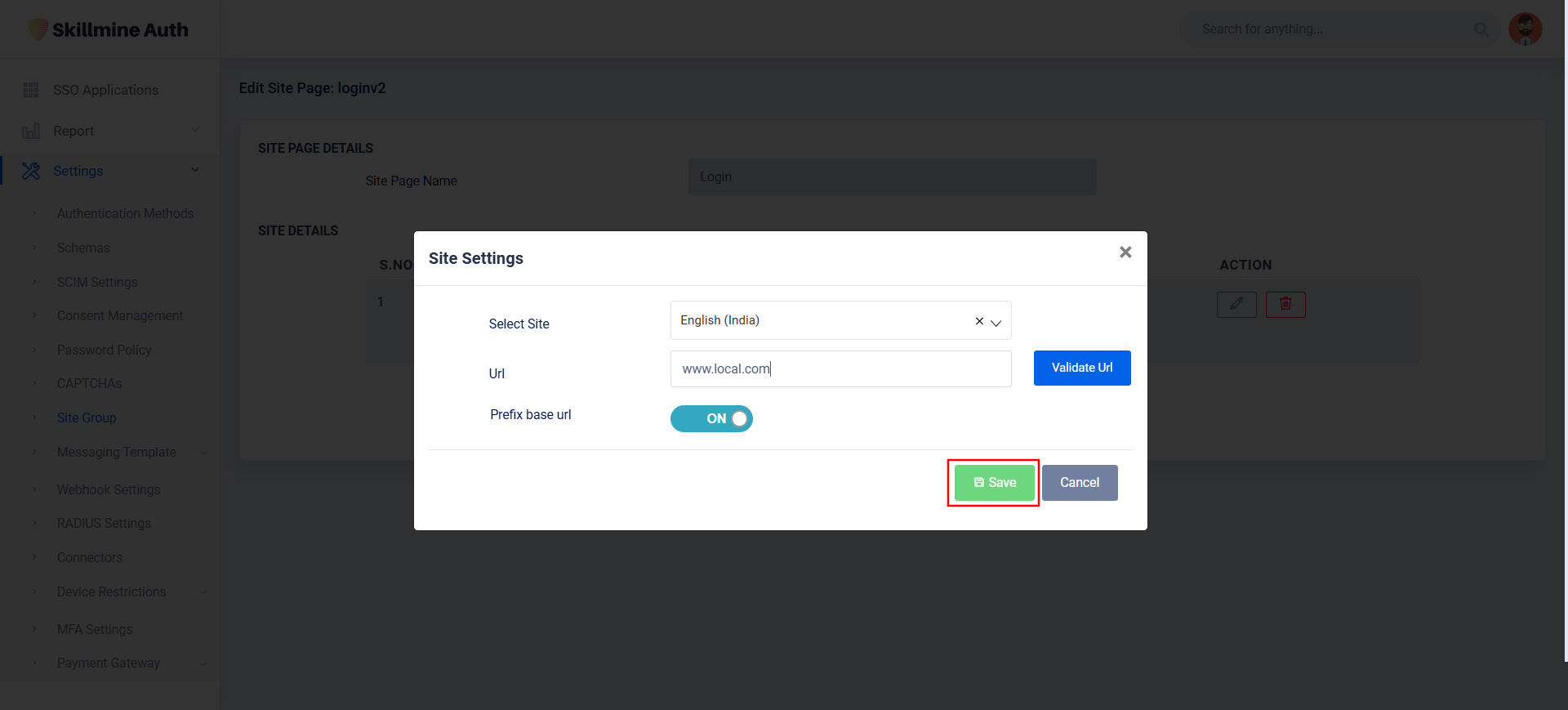
1. Click the **Create New Locale** button to initiate the process.
2. This action opens the **Locale Setting** form.
**Locale Setting Form**
1. In the Locale Setting form, you'll encounter two fields: **Select Locale** and **URL.**
2. Fill in these fields with the relevant information.
**Save Locale Settings**
* After entering the required data, click the **Save** button to store the locale settings.
#### **Edit Locale Settings:**
1. To edit existing **locale settings**, click the **Edit icon** next to the relevant entry.
2. You'll be navigate to the **Locale Setting** form for editing.
3. Make the desired modifications and **save** the changes.
#### **Delete a Locale:**
* To delete a locale, locate the **Delete** icon associated with that specific locale.
* Clicking this icon initiates the deletion process for the selected locale.
**Finalize and Save:**
* Ensure all changes are correct.
* Click the **save** button to save all the changes made.